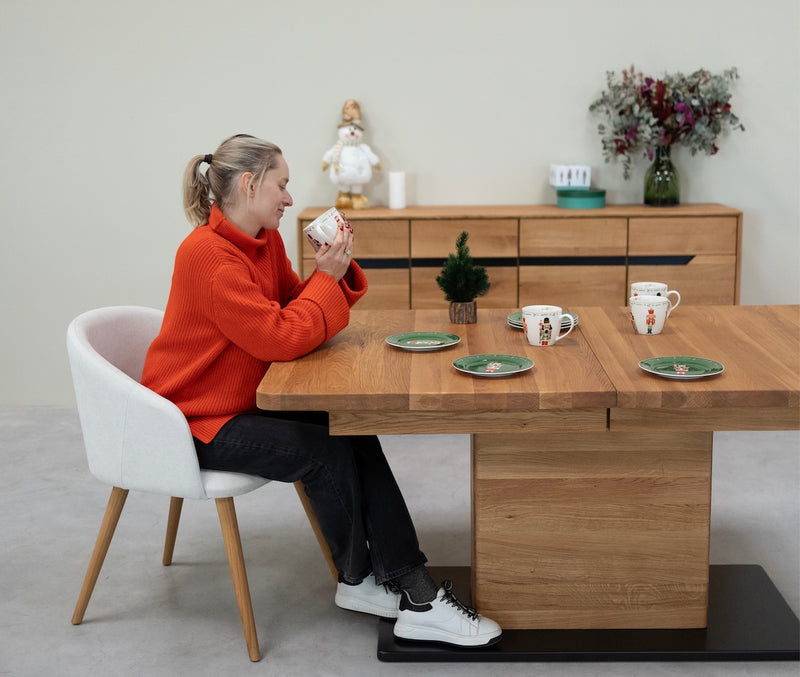
Posted by Ana Laura
on November 24, 2019

Updated in October 2026
Quick answer: Solid oak is one of the hardest, most stable, and most durable woods for furniture. It withstands daily use, doesn't warp easily, has a beautiful grain, and can be sanded and refinished for decades. When buying, make sure it’s solid oak and not veneer over particleboard, that the joints are sturdy, and that the surfaces are level and well-finished.
Oak has been used for centuries to build ships, beams, and furniture that were passed down from generation to generation. Today, it remains one of the most highly valued woods for one simple reason: it is strong, stable, and beautiful.
In this guide, we explain why you should choose solid oak furniture, how it differs from oak veneer, how it compares to other types of wood, and what to look for before buying.
Summary
- Oak trees grow slowly, which is why their wood is dense, hard, and stable.
- A piece of solid oak furniture can last for decades and can be restored.
- Oak veneer is a thin sheet of wood glued onto a less expensive board.
- Check the joints, leveling, and finish before purchasing.
- It costs more, but the higher price pays for itself over its useful life.
Contents
Advantages of oak wood
Oak trees grow very slowly, and that slow growth results in dense, highly durable wood. These are its main advantages for furniture:
- Hardness: It withstands impacts, scratches, and daily use better than softwoods.
- Stability: It is not significantly affected by changes in humidity and temperature.
- Durability: If properly cared for, a piece of solid oak furniture will last for decades.
- Distinct grain: Its wavy pattern, with knots and medullary rays, makes each piece unique.
- Versatility: It fits well with Nordic, rustic, classic, or contemporary styles.
- Restorable: It can be sanded and re-oiled or refinished to make it look like new.
Solid oak or oak veneer: the key difference
Not everything that looks like oak is solid oak. It’s important to distinguish between:
| Solid oak | Oak veneer | |
|---|---|---|
| What is | The entire piece is made of oak | Thin oak veneer glued to a board |
| Durability | Decades | Minor; the plate may come loose or wear out |
| Restoration | It is sanded and refinished several times | It is barely sandable |
| Weight | Heavy and stable | Lighter |
| Price | Taller | Lower |
Veneer has the look of oak but not its properties. If the price seems too good to be true, it's probably not solid oak. If you want to compare it with other materials, read " MDF vs. Solid Wood."
Oak Compared to Other Woods
Oak is a hardwood, like walnut, beech, or ash. Compared to a softwood like pine, it is denser, more impact-resistant, and more durable, although it is also heavier and more expensive. We explain this in detail in “Differences Between Oak and Pine Furniture.”
To see how it compares to other types of wood, check out our guide to the best woods for furniture.
What to Check Before Buying Oak Furniture
- Make sure it's solid wood: check the edges and the back. In a piece of solid wood furniture, the grain continues along the sides.
- Joints: They must be secure, with no gaps or spaces between the pieces.
- Leveling: The tabletops, shelves, and chair arms must be flat and level.
- The finish: The surface should be smooth and even, with a clear grain from end to end.
- Dimensions: Solid oak is heavy; check the dimensions of the room, the doors, and the hallways before buying.
Oak Colors and Finishes
Oak can be finished in a variety of ways that change its appearance without hiding the grain:
- Natural: a warm honey hue that takes on a slight golden tint over the years.
- Off-white: lighter and brighter, ideal for Nordic interiors and small spaces.
- Dark or stained: more elegant and classic, for traditional settings.
We explain the differences between oil, wax, and varnish in our guide to types of wood finishes.
An investment that lasts
Solid oak costs more than softwoods or plywood, but it lasts much longer. When you spread the cost over the years of use, the price is very reasonable, and many pieces are passed down from parents to children.
At Roble.Store , we pay special attention to the origin of the wood: responsible sourcing, traceability of raw materials, and supply chains from manufacturers that use wood sourced from forests managed according to recognized standards, including FSC®. And with a little care, your furniture will stay as good as new: we’ll tell you how in our guide on how to care for solid oak furniture.
Frequently Asked Questions
Why is oak so good for furniture?
Because it is a hard, dense, and stable wood: it withstands daily use, warps very little, has a beautiful grain, and can be restored for decades.
How can you tell if a piece of furniture is made of solid oak or veneer?
Look at the edges and the back: on a solid wood piece of furniture, the grain continues along the sides. Veneer is a thin sheet and usually reveals the core material at the edges.
Is oak better than pine?
Oak is harder, more stable, and more durable. Pine is lighter and more affordable, but it shows scratches more easily.
Does oak furniture darken over time?
Natural oak takes on a slightly golden hue over time as it is exposed to light. This is part of its charm; to maintain an even color, avoid prolonged exposure to direct sunlight.
Is it worth paying more for a piece of solid oak furniture?
If you're looking for a piece of furniture that will last for many years, then yes: it lasts for decades, can be restored, and retains its value.
Solid oak furniture for the entire home
Solid oak, natural finishes, and pieces built to last.
Tags:
How to Choose,
Solid Wood