Posted by Natalia Kolomiets
on August 12, 2020

Updated in October 2026
Quick answer: A round table is best for small or square dining rooms and for groups of 4 to 6 people, because it has no corners, makes it easier to move around, and allows everyone to see each other while talking. A rectangular table is best for long, narrow dining rooms and for 6 or more people, because it takes advantage of the room’s length and accommodates more chairs. If you entertain guests often, an extendable table in either shape will work for both situations.
Choosing between a round or rectangular dining table is one of the decisions that most influences how you use your dining room: how many people it seats, how easily you can move around it, and how spacious the room feels. There’s no single “best” shape in absolute terms; there is, however, a shape that’s best for your space, the number of people who typically dine there, and how you use the table. In this guide, we compare the two options—with actual measurements and examples—so you can make the right choice the first time.
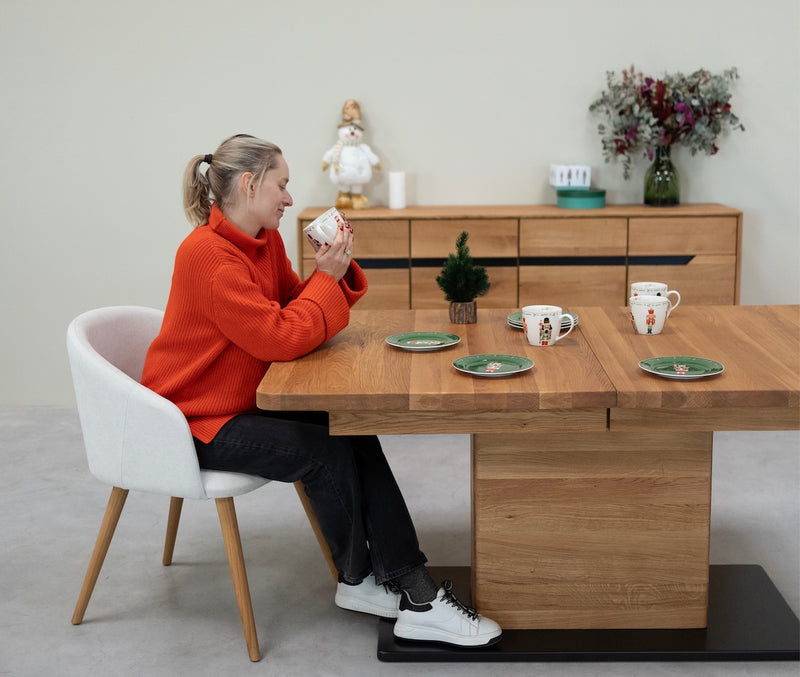
The product shown in the image is the Carmen round, extendable dining table by NordicStory, made of solid oak with an organic oil finish. It is available in diameters of 100, 110, and 120 cm and comes with an additional tabletop that transforms it into an oval shape when guests come over.
Summary
- Round table: ideal for 4 to 6 people, small or square dining rooms, and lively conversation.
- Rectangular table: ideal for 6 or more people, long dining rooms, and tables placed against the wall.
- Approximate dimensions: round tables measuring 100 to 110 cm for 4 people, and 140 cm for 6; rectangular tables measuring 160 x 80 cm for 6 people and 200 x 100 cm for 8.
- Leave 75 to 90 cm of space around the table so you can sit down and get by.
- If the number of guests varies a lot, a round or oval extendable table is the best compromise.
Contents
Round or Rectangular Table: A Quick Comparison
Before we get into the details, this table summarizes what makes each shape stand out. If your dining room clearly fits into one of the columns, you already have your answer.
| Criterion | Roundtable Discussion | Rectangular table |
|---|---|---|
| Ideal Dining Room | Square, small, or corner with a bench | Elongated or rectangular living-dining room |
| Number of guests | From 2 to 6 (up to 8 for large diameters) | From 4 to 12 |
| Traffic | With no corners, it's easy to get through | It requires more space at the ends |
| Conversation | Everyone is present, but no one is presiding | Groups form at each end |
| Next to the wall | Loses capacity | It works very well |
| Young children | Safer, with no sharp edges | It is best to choose rounded edges |
| Serving area | Child in the center of the table | Larger, with space for fonts |
When to Choose a Round Table
A solid wood round table is the most sociable option and the one best suited for compact dining rooms. Since it has no corners, it takes up less visual space, is easy to gather around, and allows you to squeeze in one more chair—something that, with a rectangular table, would require sitting in the corner.
Benefits of the Roundtable Discussion
- Easier movement: with no corners, it's easy to move around, even in tight spaces.
- Natural conversation: All diners face each other, which creates a more intimate atmosphere.
- Safer at home with children: no ledges at head height.
- Visual balance: In a square dining room, a round table placed in the center brings order to the space.
Drawbacks
For groups of 8 or more, you'll need very large table diameters, which put the center of the table out of reach for diners. It also doesn't work well when placed right up against a wall, because you lose a third of its capacity.
When to Choose a Rectangular Table
A rectangular solid-wood table offers the most efficient use of space per square meter. It fits the layout of most dining rooms, which are typically long and narrow, and easily accommodates a growing group.
Advantages of a Rectangular Table
- More seating: This is the best option for groups of 6 or more regular diners.
- Take advantage of its length: place it parallel to the wall or window, leaving the path clear.
- Usable space: There's room for vases, centerpieces, or working on your laptop.
- Pair with benches: A bench on one side saves space and seats more people.
One example is the Mauritz 3 dining table, measuring 200 x 100 cm, designed for family dining rooms that seat 8 people.
Drawbacks
In square or small dining rooms, the corners get in the way, and the table may seem larger than it actually is. In addition, those sitting at the ends are somewhat cut off from the conversation.
Sizes based on the number of people
The basic rule is to allow about 60 cm of table edge per guest. Using that as a guide, here are the approximate measurements for each shape:
| People | Round table (diameter) | Rectangular table (length x width) |
|---|---|---|
| 2 to 4 | 90 to 110 cm | 120 x 80 cm |
| 4 to 6 | 120 to 140 cm | 160 x 80 cm |
| 6 to 8 | 150 to 180 cm | 180 x 90 cm |
| 8 to 10 | Not recommended | 200 to 240 x 100 cm |
In addition to the table's dimensions, you'll need to account for the surrounding space: at least 75 cm between the edge of the table and the wall to allow for seating, and 90 cm if someone needs to walk behind it. If you want to refine your calculations, we explain the process step by step in our guide to dining table measurements. You can also go directly to our tables for 6 people or for 8 people.
What about a square or oval table?
Among the two main approaches, there are two alternatives worth considering:
- Square table: It shares the symmetry of a round table but can be placed against a wall or in a corner. It’s a great option for 2 to 4 people in open-concept kitchens and small dining rooms. Check out our square tables.
- Oval table: It combines the seating capacity of a rectangular table with the smooth curves of a round one, featuring curved ends that make it easier to move around. It’s the best choice for narrow dining rooms where you need to seat 6 or 8 people. We’ll explain everything in detail in our guide on how to choose an oval dining table.
The middle ground: an extendable table
If there are usually 4 of you but you have 8 guests several times a year, you don't have to choose. An extendable round table can be used as a round table the rest of the year and converted into an oval table when you need more space. The Carmen, for example, goes from 120 cm in diameter to 154 cm in length with its extension leaf, and the Moby extendable table reaches 170 cm in its 130 cm diameter version.
You'll find all the models in our collection of extendable round tables, and if you'd like to understand how each extension system works, check out the mechanisms of extendable tables. To complete your dining room, our guide to choosing dining chairs can help you.
Frequently Asked Questions
Which is better for a small dining room—a round table or a rectangular one?
In a small or square dining room, a round table is usually the best choice: it has no corners, takes up less visual space, and makes it easier to move around. If the dining room is small but long, a narrow rectangular table 80 cm wide can make better use of the space.
Which takes up more space, a round table or a rectangular one?
For the same number of people, a round table takes up slightly more floor space in the center but requires less space for walking around it because it has no corners. In practice, round tables are more comfortable in square dining rooms, while rectangular tables are more efficient in long, narrow dining rooms.
How many people can fit around a 120-cm round table?
A round table with a diameter of 120 cm comfortably seats 4 people, and up to 5 if everyone squeezes in a bit. For 6 people to sit comfortably, the recommended diameter is 140 cm.
What is the best table shape for 8 people?
For 8 people, a rectangular or oval table measuring about 200 x 100 cm is best. A round table for 8 needs to be at least 180 cm in diameter, which puts the center out of reach of the diners and requires a very spacious dining room.
Which table is best if you have small children at home?
A round table is the safest option because it has no corners at children's head height. If you prefer a rectangular table due to space constraints, choose a model with rounded edges.
Find your solid oak dining table
Round, rectangular, and extendable, made of solid oak and finished with natural oil.