Posted by Ana Laura
on February 06, 2025

Updated in October 2026
Quick answer: Solid wood is better than MDF for everyday, long-lasting furniture—such as tables, chairs, beds, or dressers—because it can support more weight, can be sanded and refinished, and lasts for decades. MDF is better when you’re on a tight budget or for pieces that will be lacquered or painted, such as cabinet fronts or kitchen doors, because it’s inexpensive, stable, and has a completely smooth surface. Its weakness is moisture and impact: once damaged, it cannot be repaired.
In the showroom, this is one of the questions we hear most often: Why does a piece of solid wood furniture cost more than one made of MDF that looks the same? The answer lies inside the furniture, not on the surface. In this guide, we compare MDF and solid wood point by point (strength, durability, moisture resistance, price, aesthetics, and sustainability) so you can determine which is best for each situation.
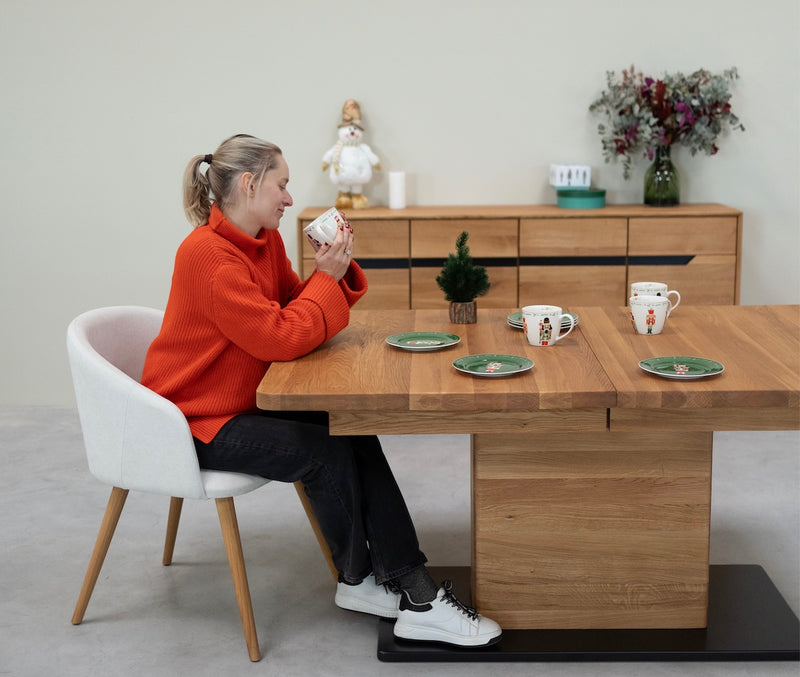
The product shown in the image is the Mauritz 3 dining table by NordicStory, made entirely of solid oak, measuring 200 x 100 cm and weighing about 91 kg—an example of everyday furniture designed to last for several generations.
Summary
- MDF: a panel made of wood fibers pressed together with resins. Inexpensive, smooth, and stable, but susceptible to moisture and difficult to repair.
- Solid wood: pieces made of natural wood. More durable, repairable, and long-lasting; more expensive initially.
- For tables, chairs, beds, and dressers, solid wood is the best choice for durability.
- For lacquered cabinet fronts or temporary projects, MDF is a reasonable option.
- MDF is not the same as particleboard: MDF uses fine fibers; particleboard uses wood chips.
Contents
What Is MDF?
MDF ( Medium Density Fiberboard) is a board made from very fine wood fibers mixed with resins and wax and pressed at high temperatures. The result is a uniform panel, free of grain and knots, with a completely smooth surface. That is why it is so commonly used in lacquered furniture, kitchen cabinets, and low-cost ready-to-assemble furniture.
It should not be confused with particleboard, which is made from wood shavings and coarser particles and is even less durable, nor with plywood, which consists of sheets of wood glued together in cross-plied layers.
What Is Solid Wood?
Solid wood is natural wood cut directly from the trunk, without being ground down or reconstituted. Each piece retains its original grain, density, and strength. In furniture, hardwoods such as oak, walnut, and beech are the most highly valued for their hardness and stability. If you’d like to learn more, we explain what solid wood is and which woods are best for furniture.
MDF vs. Solid Wood: Comparison Chart
| Criterion | MDF | Solid wood |
|---|---|---|
| Composition | Pressed wood fibers, resins, and wax | Solid wood or glued-together pieces |
| Weight resistance | Average; the long shelves warp | High; hardwoods hardly warp at all |
| Humidity | It swells if water gets into the edges or screws | It moves slightly but regains its shape |
| Dents and Scratches | The damage is permanent | Sand it down and refinish it |
| Screws and Hinges | They lose their grip after being removed several times | They maintain their grip for years |
| Aesthetics | Standard; requires a badge, lacquer, or paper | Natural grain—each piece is unique |
| Durability | Years | Decades or generations |
| Starting price | Bass | Taller |
Key Differences, One by One
Strength and Durability
Solid wood—especially oak—can support much more weight without warping. On an MDF bookshelf loaded with books, the long shelves eventually bend; on solid oak, they stay straight. The same is true for drawers, legs, and the joints of chairs and tables, which are the parts that suffer the most from daily use.
Humidity
This is MDF’s biggest weakness. As long as the finish remains intact, it holds up well; but if water gets in through an edge, a screw hole, or a scratch, the fibers swell and the board won’t return to its original shape. There are water-resistant versions for kitchens and bathrooms, but they still can’t match well-finished solid wood.
Repair and Maintenance
A piece of solid wood furniture can be sanded, oiled, and restored to like-new condition, even after years of use. MDF furniture, on the other hand, cannot be deeply sanded: a dent or burn mark will remain permanently. To maintain solid wood, simply apply oil from time to time, as we explain in our guide to tung oil and in our guide to types of wood finishes.
Aesthetics
MDF is perfect for smooth lacquered finishes, but it always needs a coating. Solid wood shows its natural grain, which varies from piece to piece and gains character over the years.
Price and Sustainability
MDF is cheaper to buy, but it usually needs to be replaced sooner. Solid wood from responsibly managed, FSC-certified forests lasts much longer and stores carbon throughout its useful life. If you calculate the cost per year of use, a piece of solid wood furniture is usually more cost-effective.
When to Choose MDF and When to Choose Solid Wood
| Furniture | Recommendation | Why |
|---|---|---|
| Dining table | Solid wood | Withstands daily weight, heat, and friction |
| Chairs | Solid wood | The connections do not loosen with use |
| Bed | Solid wood | Sturdy, creak-free structure |
| Chest of drawers and drawer units | Solid wood | Straight drawers after years of use |
| Lacquered cabinet fronts | MDF | Smooth surface ideal for painting |
| Temporary furniture | MDF | Lower initial investment |
You can see how this translates into actual furniture in our solid wood dining tables, our solid wood beds, and our solid wood dressers.
How to Tell the Difference Between MDF Furniture and Solid Wood Furniture
- Look at the edges: on solid wood, the grain continues along the edge; on MDF, you'll see a uniform edge or a glued-on veneer.
- Look for the grain on the reverse side: on the bottom or back, the MDF has a smooth, uniform color.
- Check the product specifications: a solid wood manufacturer specifies the wood species (oak, walnut) and does not refer to "oak finish" or "wood-look finish."
- Check the weight and the sound: tapping it with your knuckles produces a fuller, more natural sound on solid wood.
If you're not sure which wood type to choose, you might be interested in our comparison of oak and pine furniture.
Frequently Asked Questions
Is MDF good for furniture?
MDF is good for low-cost furniture or pieces that will be painted, such as cabinet fronts or kitchen doors. It is not the best choice for heavy-duty furniture, such as tables, chairs, or dressers, because it is sensitive to moisture and impact and cannot be repaired.
Which lasts longer, MDF or solid wood?
Solid wood lasts much longer. A well-maintained piece of solid oak furniture can last for several generations, while MDF furniture usually lasts only a few years, especially if it is exposed to moisture or assembled and disassembled multiple times.
What is the difference between MDF and particleboard?
Both are engineered wood panels, but MDF is made from very fine wood fibers, while particleboard is made from coarser wood chips. MDF is denser, smoother, and stronger than particleboard, although both are inferior to solid wood.
Is MDF moisture-resistant?
Standard MDF does not hold up well to moisture: if water penetrates it, the board swells and does not return to its original shape. There are water-resistant versions available for kitchens and bathrooms, but solid wood with a good oil finish stands the test of time better.
Why is solid wood furniture more expensive?
Because they require more raw materials, controlled wood drying, and more precise carpentry work. In return, they last for decades, can be repaired, and retain their value, so their cost per year of use is usually lower.
Solid oak furniture
Solid oak furniture certified by the FSC, finished with natural oil.
Tags:
How to Choose,
Solid Wood