Posted by Ana Laura
on October 15, 2024

Updated in October 2026
Quick answer: The Nordic or Scandinavian style is based on light, functionality, and natural materials. Its furniture features simple lines, is made of light woods like oak, and is paired with a palette of whites, grays, and sandy tones, along with linen and wool textiles and plenty of natural light. You can adopt it gradually: lighten up your color palette, declutter, and choose a few key wooden pieces of furniture.
Few styles have stood the test of time as well as the Nordic style. It originated in the Scandinavian countries, where winters are long and dark, as a way to fill the home with light, calm, and warmth.
In this guide, we'll explain what characterizes Nordic-style furniture, what colors, materials, and accessories define it, and how to incorporate it into your home without having to change everything.
Summary
- Three pillars: natural light, functionality, and natural materials.
- Furniture with clean lines made of light-colored woods, primarily oak, beech, and ash.
- A neutral color palette (white, gray, sand) with a few soft pops of color.
- Layered natural fabrics: linen, cotton, and wool.
- You can incorporate it gradually, pairing it with the furniture you already have.
Contents
- What Is the Nordic or Scandinavian Style?
- Characteristics of Nordic and Scandinavian Furniture
- Colors in Scandinavian Decor
- Materials, textiles, and lighting
- 8 Key Elements of a Scandinavian Interior
- How to Bring the Nordic Style into Your Home Without Changing Everything
- Nordic-Style Living Room, Bedroom, and Dining Room: Ideas by Room
- Frequently Asked Questions
What Is the Nordic or Scandinavian Style?
Scandinavian interior design became popular in Europe in the mid-20th century by combining Nordic tradition with the clean lines of modern design. Its central idea is simple: a home should be bright, tidy, and pleasant to live in.
That's why every piece has a clear purpose, and nothing is superfluous. Warmth isn't achieved with lots of objects, but with high-quality materials, soft textiles, and thoughtful lighting. It's the foundation of the Danish concept of hygge: feeling at home.
It has close relatives, such as Scandinavian minimalism—which is even more refined—or the Japandi style, which blends Nordic design with Japanese aesthetics.
Characteristics of Nordic and Scandinavian Furniture
These are the features that distinguish Nordic-style furniture:
| Feature | What to Look For |
|---|---|
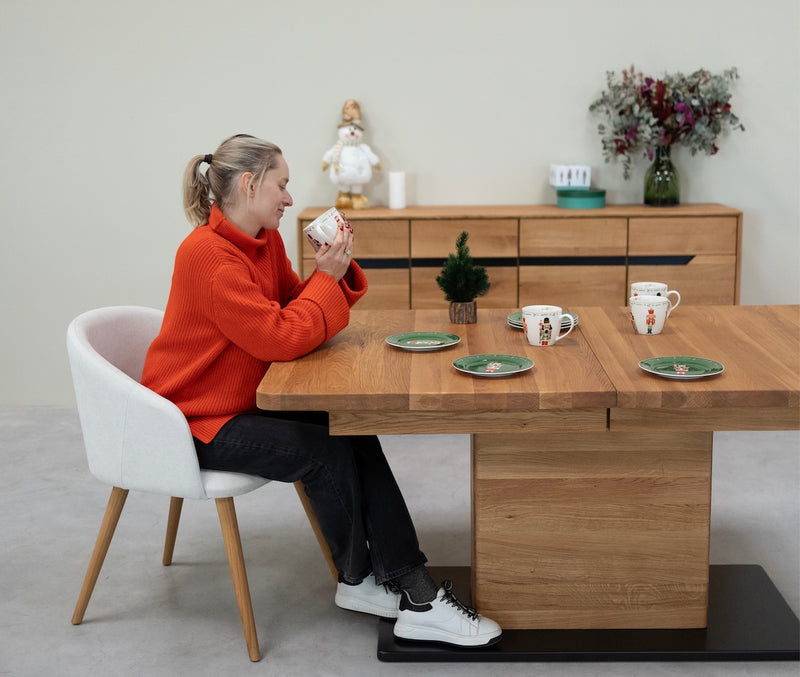
| Light-colored wood | Natural or bleached oak, beech, ash. The grain is visible. |
| Simple Lines | Geometric shapes, without moldings or ornamentation. |
| Slender legs | Wooden legs, often slanted, that make the piece of furniture appear lighter. |
| Functionality | Built-in storage, drawers, shelves, or pieces that serve more than one purpose. |
| Natural finishes | Matte oil or varnish that preserves the natural feel of the wood. |
| Durability | Solid wood instead of particleboard, for furniture that lasts for decades. |
Solid wood is key: it ages well, can be restored, and adds warmth that balances neutral colors. You'll find all these features in our NordicStory collection.
Colors in Scandinavian Decor
The Nordic color palette aims to maximize natural light:
- Base: white, off-white, light gray, and sand tones on walls and large pieces.
- Warmth: beige, soft terracotta, and, above all, the shade of light wood.
- Accent colors: sage green, dusty blue, soft pink, or mustard yellow—in throw pillows, artwork, or a single piece of furniture.
- Contrast: black or anthracite gray on frames, light fixtures, or handles, to add depth.
The golden rule: neutral tones for large surfaces and color for small ones. If you want to paint, start with white or nearly white walls and let the wood add the color.
Materials, textiles, and lighting
The Scandinavian style is a tactile style. It works with layers of natural textures:
- Wood: in furniture, flooring, and small objects.
- Textiles: linen, cotton, and wool in cushions, blankets, sheer curtains, and rugs.
- Ceramics and glass: vases, decorative plates, and candleholders with simple shapes.
- Leather and metal: in small doses, in an armchair or a lamp.
Lighting is essential. Make the most of natural light, remove heavy curtains, and combine various sources of warm light: ceiling lights, floor lamps, table lamps, and candles. This will create a cozy atmosphere at any time of day.
8 Key Elements of a Scandinavian Interior
- Wooden freestanding coat rack: open, lightweight storage, ideal for small apartments.
- Open shelving: for books, pottery, and photos. Discover our modern shelving units.
- Light-wood dining table: the heart of home life.
- Nordic-style wooden chairs: Check out our Nordic-style wooden chairs.
- Linen and wool textiles: layered blankets and cushions.
- Prints and paintings: botanical or black-and-white motifs, with slim frames.
- Mirror: It reflects light and visually enlarges the room.
- Plants and flowers: even a single branch in a clear vase adds a touch of beauty.
How to Bring the Nordic Style into Your Home Without Changing Everything
You don't have to renovate the whole house. These steps will help you achieve a Scandinavian style with what you already have:
- Create a brighter space: lighten the walls and replace heavy curtains with lighter ones.
- Reduce clutter: put away or rearrange small items so that no area looks overcrowded.
- Add natural materials: a wool rug, blankets, baskets, or a piece of light-colored wood furniture.
- Combine clean lines with organic shapes: don't get rid of the rounded pieces you like; they add softness.
- Use color wisely: save your favorite colorful pieces for accents against a neutral background.
- Add some greenery: plants bring balance to any minimalist space.
Nordic-Style Living Room, Bedroom, and Dining Room: Ideas by Room
- Living Room: a light-colored sofa, a wooden coffee table, a wool rug, and an open shelving unit. More ideas on how to achieve the Nordic style in your living room.
- Dining Room: a solid-wood dining table with simple lines, wooden chairs, and a pendant light.
- Bedroom: wooden bed, linen bedding, and simple nightstands. Get inspired by our 20 Scandinavian bedroom ideas.
Frequently Asked Questions
What characterizes Nordic style furniture?
Simple lines, light-colored woods such as oak, slender legs, functionality, and natural finishes that showcase the wood grain.
What colors are used in Scandinavian interior design?
Whites, light grays, and sandy tones as a base, with the natural color of wood to add warmth and soft accents such as sage green, dusty blue, or mustard.
Are Nordic furniture and Scandinavian furniture the same thing?
Yes. "Scandinavian" refers to Denmark, Sweden, and Norway, and "Nordic" also includes Finland and Iceland, but in interior design, both terms describe the same style.
Can Nordic furniture be combined with other styles?
Yes. Its simple design pairs well with rustic, modern, or industrial pieces. Just stick to a neutral color palette and don't overcrowd the space.
What is the most typical type of wood used in the Nordic style?
Light-colored woods: oak, beech, ash, and birch. Oak is the most durable of all and can be finished with a natural or bleached finish.
Do you have to replace all your furniture to have a Scandinavian-style home?
No. Lightening the walls, reducing the number of objects, adding natural textiles, and incorporating a few key wooden pieces can completely transform the feel of the space.
Nordic-style solid oak furniture
Simple lines, light-colored wood, and pieces built to last.
Tags:
Decor and ideas,
Solid wood