Posted by Ana Laura
on September 9, 2026

Quick answer: An oval dining table combines the seating capacity of a rectangular table with the ease of movement around a round one—since it has no corners, it’s easier to move around, and it can seat one or two more people along the same length. It’s the best option for narrow or walk-through dining rooms. And here’s a little-known fact: most extendable round tables become oval when extended, so you often don’t have to choose between the two shapes.
Guide Contents
- Why Choose an Oval Table
- The round table that turns into an oval one
- Oval, round, or rectangular: which one fits in your dining room?
- Servings and Guests
- The circulation space that must be set aside
- Extendable Oval: When It's Worth It
- How many chairs fit, and what kind?
- Why Solid Oak?
- Caring for an Oval Wooden Table
- Frequently Asked Questions
The oval table is the least popular of the three shapes, and yet, in many actual dining rooms, it works best. It’s often ruled out out of habit—because conversations always seem to center on round or rectangular tables—and yet it solves exactly the problem faced by most Spanish dining rooms: they’re long, narrow, and designed for passing through.
This guide explains when an oval shape is the right choice, what sizes you need based on the number of guests, and why the line between round and oval is much more blurred than it seems.
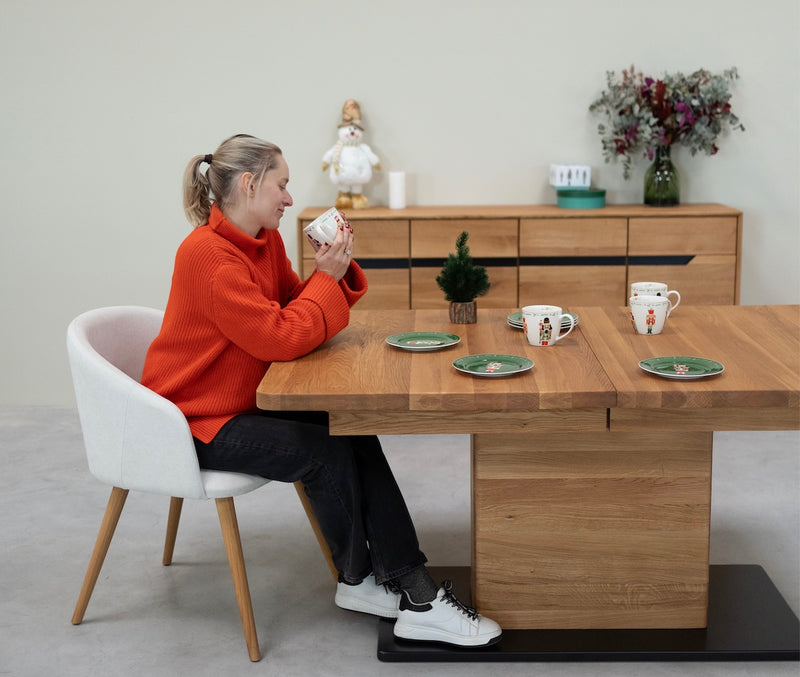
The product shown in the image is the Escandi 2 dining table, made of solid oak. It is oval-shaped and extendable, with rounded edges all around and a central extension mechanism.
Why Choose an Oval Table
The advantage of the oval shape is best understood if you think about what it lacks compared to a rectangular one: the four corners. And those corners are responsible for three everyday problems.
The first is circulation. In a narrow dining room, the corner of a rectangular table is exactly where you bump your hip as you walk by. A curved edge allows you to pass closer to the table without brushing against it, which in practice means gaining several centimeters of clearance on each side.
The second is conversation. At an oval table, all the diners have a line of sight to everyone else, something that is lost at a long rectangular table for those sitting at the ends.
The third factor is safety, which is especially important if there are small children at home: with no corners at head height, the most common point of impact in the dining room is eliminated.
The round table that turns into an oval one
This is the point that causes the most confusion and the one that most often influences purchasing decisions. The vast majority of extendable round tables do not extend in a circle, because that is geometrically impossible: they open from the center and add a straight tabletop between the two halves. The result, when the table is open, is an oval table.
This means that an extendable round table offers both shapes in a single piece of furniture: round for everyday use, seating four people, and oval when extended to accommodate guests. If you were torn between the two shapes, you may not have to decide at all. You can view the models that work this way in the extendable round table collection, and learn more about the opening mechanisms of extendable tables.
A fixed oval table, on the other hand, makes sense when the dining room is permanently elongated and you want the full seating capacity to be available at all times, without having to operate any mechanisms.
Oval, round, or rectangular: which one fits in your dining room?
Choose an oval table if your dining room is long and narrow, if the table is in a high-traffic area, if you want to seat six or eight people without sacrificing space to move around, or if you have small children at home.
Choose a round table if your dining room is square or nearly square, if there are usually four of you, or if you want a piece that serves as the focal point of the room.
Choose a rectangular shape if you have a long wall against which to place it part of the time, if you need the maximum usable area per square meter, or if the dining room is wide enough that the corners won't get in the way.
We've compared the two most common styles, using floor plans and specific examples, for round and rectangular dining tables.
Servings and Guests
The general rule is that each diner needs about 60 cm of table perimeter to eat comfortably. At an oval table, the curve at the ends makes better use of that perimeter than the corners of a rectangular table, and that’s where the real gain in seating capacity lies.
As a practical guide, an oval table about 160 cm long comfortably seats six people; one measuring 180 to 200 cm can seat eight. The width usually ranges from 90 to 110 cm, and it’s best not to go below 90 cm if you plan to set the table with plates, serving dishes, and glasses at the same time.
One detail that makes a big difference in the table’s actual capacity: the position of the legs. A table with a central leg or legs set back toward the center allows you to add an extra chair at the ends, which is impossible if the legs are at the corners. The complete calculation, based on the number of diners and the size of the room, can be found in our guide to dining table dimensions.
The circulation space that must be set aside
It's the measurement that's often overlooked, yet it determines whether the dining area works. You need to account for two different things: the space needed to pull out a chair and sit down—which is about 75 cm from the edge of the table—and the clearance needed to walk behind someone who is seated, which requires between 100 and 110 cm.
If your dining room isn't wide enough to accommodate 100 cm on all sides, an oval shape is exactly what you need, because the narrower ends free up space right where a rectangular table would block it with its corners.
Extendable Oval: When It's Worth It
An extendable oval table makes sense in a very specific scenario: daily use by four to six people, with occasional peaks of eight or ten during family meals. If those peaks occur several times a month, it’s worth it. If they occur twice a year, you’ll probably be better off with a fixed-size table that matches your actual needs and folding chairs stored away.
There are two things you should check before buying: where the extension leaf is stored—whether it fits under the table itself or if you need to find space for it in another piece of furniture—and how much free space you need around it to open it. You can view the available models of extendable oval tables.
How many chairs fit, and what kind?
In an oval table, the chairs at the ends are what set it apart from a rectangular table of the same length. The curve allows them to be placed at a slight angle, providing elbow room without sacrificing space.
Regarding the type, here are two practical considerations. Chairs with armrests take up an additional 10 to 15 cm of space around the perimeter, so it’s a good idea to count them before assuming that eight will fit. And if the dining room is narrow, a chair that tucks completely under the tabletop frees up space when not in use. The complete guidelines can be found in “How to Choose Dining Chairs.”
Why Solid Oak?
The material is more noticeable on an oval table than on a rectangular one, for one specific reason: the curved edge. On a veneered particleboard tabletop, the curve requires a glued edge that runs along the entire perimeter, and that edge is the first part to come loose with use and cleaning. With solid oak, the curve is machined directly into the wood itself, with no joint to give way.
This is also where the grain is visible, because a rounded edge reveals the board's actual thickness along its entire perimeter. A solid edge and a veneered edge can be distinguished at a glance precisely there.
Caring for an Oval Wooden Table
Maintenance is the same as for any solid oak table: use a dry or slightly damp cloth, avoid abrasive products, place coasters under hot and wet items, and apply a specialized oil every 12 to 24 months. With an oval table, there’s one extra area to pay attention to: the curved edge, which experiences more wear than a straight edge because people walk close to it. It’s worth including this area when it’s time to apply oil.
If the table is extendable, you should also clean the mechanism's guide once a year. For complete tips, see " How to Protect a Wooden Table."
Frequently Asked Questions
How many people can fit around an oval dining table?
An oval table about 160 cm long comfortably seats six people, and tables ranging from 180 to 200 cm long can seat eight. The general guideline is about 60 cm of space per diner, and the placement of the legs may allow for an extra chair at either end.
Can an extendable round table be converted into an oval one?
Yes, on most models. When you open it in the middle and add a straight tabletop between the two halves, the table changes from a circle to an oval. That's why an extendable round table actually offers both shapes in a single piece of furniture.
Is an oval or rectangular table better?
An oval table is ideal for narrow or walk-through dining rooms because, since it has no corners, it improves traffic flow and safety around children. A rectangular table makes better use of space if the dining room is wide or if you plan to place it against a wall.
How much space should you leave around an oval table?
About 75 cm from the edge to pull out the chair and sit down, and between 100 and 110 cm if you also need to walk behind someone who is seated. The oval shape is especially helpful when you can't quite reach that measurement on all sides.
How wide should an oval dining table be?
Between 90 and 110 cm. Anything under 90 cm is just enough to fit plates, serving dishes, and glasses at the same time without diners sitting across from each other getting in each other's way.
Why choose an oval solid wood table?
Because of the curved edge. On a veneered tabletop, the curve requires a glued edge that runs along the entire perimeter and eventually comes unstuck with use. With solid oak, the curve is machined directly into the wood itself, with no joint that could give way.
Oval dining tables made of solid oak
Discover our oval solid oak tables, available in both fixed and extendable versions, built to last for generations.
View oval solid wood tables