Posted by Ana Laura
on July 31, 2026

Quick answer: Setting up a home office that will work in the long term depends on four decisions, in this order: the space (choosing a corner with natural light and visual separation from the rest of the house), the desk and chair (the two pieces that will withstand daily use), storage (to keep the work surface clear at all times), and, last but not least, the decor.
Guide Contents
- Before you buy anything: Choose your space carefully
- The desk: the centerpiece of your home office
- The chair: the piece of furniture that determines whether you can make it through the day
- Storage and Organization: Shelves, Drawers, and Clear Counter Space
- How to Arrange a Small Home Office
- Lighting and wiring: the details that become apparent by the third week
- Decor: Don't make it look like a real office
- Which Desk to Choose Based on Your Work Style
- Frequently Asked Questions
Setting up a home office isn't just about buying a desk and putting it in a corner. It's about deciding which part of the house you're going to set aside for work, which pieces of furniture will withstand daily use for years to come, and how to keep that corner from becoming cluttered with cables, papers, and things that have nowhere else to go.
This guide walks you through the decisions in the order that really matters: first, the space and essential furniture—desk, chair, and storage—and only at the very end, the aesthetic aspects. It’s the same order we’d follow if we had to set up our own office from scratch.
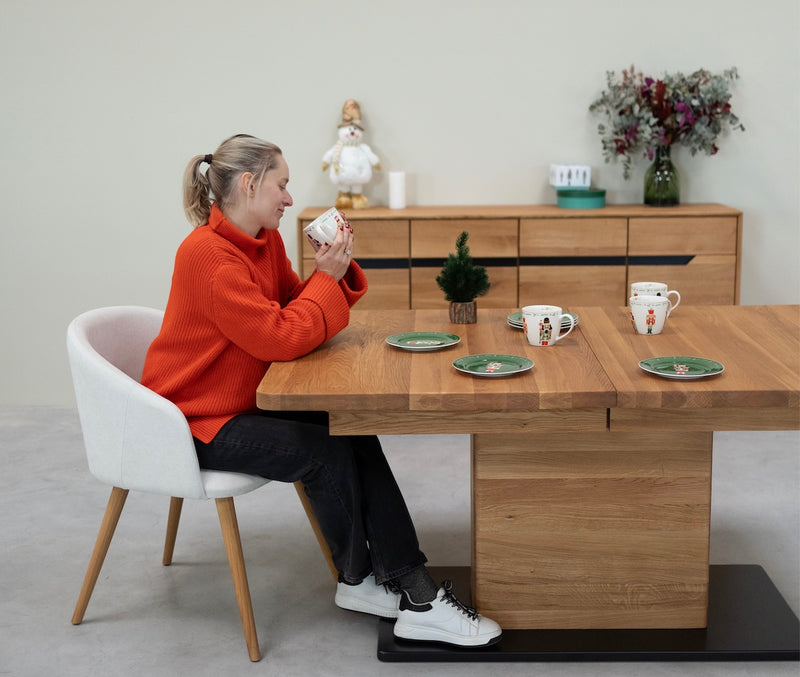
The product shown in the image is the Ana desk made of solid oak, featuring a raised monitor stand that incorporates two drawers and leaves the central space open for the keyboard, keeping the work surface uncluttered without sacrificing storage space.
Before you buy anything: Choose your space carefully
The most common mistake when setting up a home office is choosing the furniture first and the space second. Before looking at catalogs, it’s a good idea to decide where that workspace will go: a spare bedroom, a corner of the living room, or the space under the stairs are the three most common options, and each one comes with its own set of conditions.
Three factors carry more weight than the rest when making this choice: natural light (working with your back to a window or facing one completely changes how the workday feels), visual separation from the rest of the house—even if it’s just with a bookshelf or a screen—and noise, since a spot next to the kitchen or the entryway rarely works well in the long run.
The desk: the centerpiece of your home office
Your desk is the piece of furniture you’ll use the most, and it’s also the first thing you’ll notice if you’ve made a poor choice: a tabletop that sags, a drawer that doesn’t close properly, or a desk that’s too narrow for two monitors are problems you’ll face every day. We’ve put together a comprehensive guide covering material, dimensions, and height considerations in “Wooden Desks: A Complete Guide for the Home Office.”
To sum it up quickly: choose solid oak over MDF or particleboard, adjust the width and depth to fit the actual available space, and make sure the work surface is between 74 and 76 cm high.
The chair: the piece of furniture that determines whether you can make it through the day
A poorly chosen chair is by far the most common cause of back and neck pain when working from home. The height of the chair and the desk are always linked: if you have questions about how to adjust them together, we have a specific guide on what height your office chair should be. You can view the solid wood models available in our collection of wooden office chairs.
Storage and Organization: Shelves, Drawers, and Clear Counter Space
Clutter in a home office builds up quickly, especially if the desk is the only storage space in the room. The most effective solution isn’t to buy more boxes or organizers, but to address storage with a built-in piece of furniture from the start: a bookshelf next to the desk can hold books, file folders, and office supplies without taking up desk space. You can view the complete catalog in our collection of solid wood bookshelves.
As a rule of thumb: if the desk has its own drawer, the bookshelf can be more decorative than functional; if the desk is plain, without drawers, the bookshelf becomes the room’s main storage space, and it should be sized accordingly.
How to Arrange a Small Home Office
A small home office has its own set of rules. With limited space, every piece of furniture has to earn its place: a desk that’s 100 to 120 cm wide, a chair that can be tucked completely under the desk when not in use, and vertical storage—such as a tall, narrow bookshelf—rather than horizontal storage.
If your workspace is located within a room that serves another purpose—such as a bedroom or living room—a bookshelf or a low screen can create a visual transition between “work mode” and the rest of the space, without the need for an entire wall.
Lighting and wiring: the details that become apparent by the third week
Natural light coming from the side—not directly in front of or behind the screen—causes the least eye strain during the day. For times when there is no natural light, an adjustable desk lamp with warm-to-medium light temperature (3,000 to 4,000 K) is more comfortable for long sessions than a cool-toned ceiling light.
Wiring is often the last detail to be considered and the first to be noticed: a power strip mounted under the countertop or a cable tray prevents a visible tangle of cables that, over time, ends up looking more like neglect than style.
Decor: Don't make it look like a real office
A home office doesn't have to look like an office. Solid wood helps with exactly that: it adds visual warmth through the furniture itself, without relying on additional accessories. A plant, a couple of picture frames, and a clutter-free workspace often add more character than any purely decorative element.
As a general rule, the fewer permanent items there are on your desk, the easier it is to keep it tidy on a daily basis. Decor works best around the desk, on the bookshelf, or on the wall, rather than on the desk surface itself.
Which Desk to Choose Based on Your Work Style
Not every home office needs the same type of desk. Someone who only uses a laptop for a few hours a day has very different needs than someone who sets up a permanent workstation with dual monitors and physical documents. We review the most common styles—L-shaped, straight, or with built-in shelving—in our guide , “Types of Desks: Which One to Choose.”
Frequently Asked Questions
What's the first thing I need to decide when setting up a home office?
The space comes before the furniture. Natural light, the visual separation from the rest of the house, and the noise level in that corner have a greater impact on the final result than any specific piece of furniture.
What pieces of furniture are truly essential in a home office?
A desk, a chair, and a storage unit—in that order of priority. Decor is the final touch, not the first decision.
How do you organize a small home office?
With a desk that's 100 to 120 cm wide, a chair that tucks completely under the desk, and vertical storage using a tall, narrow bookshelf instead of a large horizontal piece of furniture.
What kind of lighting is best for working from home?
Natural side lighting during the day, and at night, an adjustable desk lamp with a warm-to-medium light temperature, between 3,000 and 4,000 K, for long sessions in front of the screen.
How can I decorate my home office without making it look like an office?
Prioritize solid wood furniture, which adds warmth without relying on accessories, and keep the desk clear. Decor works best on the bookshelf or the wall rather than on the desk surface itself.
Set up your home office with solid oak furniture
Discover desks, chairs, and bookshelves made of solid oak, designed to last in your workspace.
View solid wood desks
Tags:
Decor and Ideas,
Office